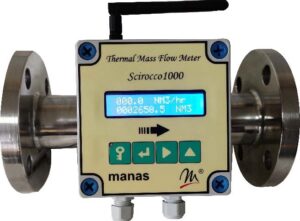
Thermal Mass Flow Meter
About-
Thermal mass flow meters,
also known as thermal dispersion or immersible mass flow meters, are used to
measure total mass flow rate of a fluid, primarily gases, flowing through
closed conduits. It is a direct mass
flow meter with no moving parts.
Theory of Operation-
A Thermal Mass Flow
Meter contains two temperature sensors for this purpose. Single sensor
measures the fluid temperature as a reference. The second sensor is heated and
has a constant temperature differential relative to the main sensor. When the
flow of air/gas starts heat is taken absent from the warmer sensor. The quantity
of heat taken away is having a direct relation with the mass velocity of the
fluid. That is how it is a straight mass flow meter.
Being a through mass flow
meter, it does not require any pressure and temperature compensation.
Types-
There are two types of Thermal Mass Flow meters:
1- Thermal Dispersion/Immiscible Type: In case of Thermal dispersion or immersible type,
the heat is transferred to the layer of the flowing fluid coming in contact
with the heater surface. The convected heat from the surface of the heating
element is related to point mass velocity of the fluid.
2- Capillary Tube Type: In second type, i.e.
capillary type thermal mass flow meter, the heat is transferred to bulk of
fluid passing through the small heated capillary tube.Although the principles
of operation of both types depend on heat convected, both methods are quite
different. Thermal dispersion flow meters are commonly used for general
industrial gas flow applications in pipes and ducts and hence are more popular
for such industrial applications. The capillary types are primarily used for
smaller flows of clean gases or liquids in tubes.
How does a thermal mass flow meter work?
The thermal mass meter measures gas flow based
on convective heat transfer. The Sage flow meters are obtainable in either
inline flow bodies or insertion-style.
In any case, the meter’s probe supplements into a gas stream of a pipe,
stack, or duct. Toward the tip of the meter’s probe are dual sensors. These
sensors are resistance temperature detectors (RTDs) or resistance thermometers
that measure temperature. The RTDs consist of tough reference-grade platinum
windings clad in a protective 316 SS or Hastelloy C sheath.
One RTD is heated by an integrated circuit and
purposes as the flow sensor, while a second RTD acts as the reference sensor
and determines the gas temperature. The Sage branded circuitry maintains a
continuous overheat between the flow and reference sensors. As gas flows by the
heated RTD, drifting gas molecules transport heat away from it, and as a outcome,
the sensor cools, and the energy escapes. The circuit balance disrupts, and the
temperature change (ΔT) between the heated RTD and the reference RTD changes.
The circuit restores the lost energy within a additional by heating the flow
sensor to adjust the overheat temperature.
The electrical
power mandatory to sustain this overheat denotes the mass flow signal.
What are the advantages of thermal mass flow
meters?
·
Thermal
flow meters have no moving parts, reducing maintenance and permitting the use
in demanding application areas, including saturated gas.
·
Gas
mass meters calculate mass flow rather than volumetric flow. They do not
require temperature or pressure alteration, so there is no additional expense
for purchasing and installing other equipment.
·
Thermal
flow meters provide excellent accuracy and repeatability over a wide range of
flow rates.
·
Thermal
flow meters can degree flow in large pipes.
·
Thermal
mass flow meters are by far the most popular instruments for determining mass
flow of low gas flow. Since the introduction of these instruments in the mid-1970s,
they have undergone considerable growth, from analogue to digital, from low
flow to higher flow, from applications in laboratories and machines to
industrial environments and even hazardous areas. There is a suitable thermal
mass flow meter for almost each low-flow gas application. Other measurement
principles that can be used for low-flow gas uses are Coriolis flow measurement
and differential pressure measurement
What are the Applications of thermal mass flow meters?
Thermal mass flow meter is used in variety of
gas flow applications such as-
·
Compressed
air/ Gas Consumption measurement
·
Gas
measurement at very low-pressure flowing conditions
·
Fuel
Gas like CNG consumption measurement and control
·
Automobile
gas engine testing
·
Industrial
oxygen flow measurement and control
·
Furnace
and burner control
·
Biogas
measurement in digester biogas digester systems
So Many Companies In India That Provide The Thermal Mass Flow Meter But I Am Suggest You One Of The Best Thermal Mass Flow Meter Supplier, Manufacture And Dealer Company If You Want To Know More About This Product And Buy This Product Then Visit Here Manas Microsystem Pvt. Ltd

Comments
Post a Comment